The Multiplication Problem: Skill Without Belief, Belief Without Skill
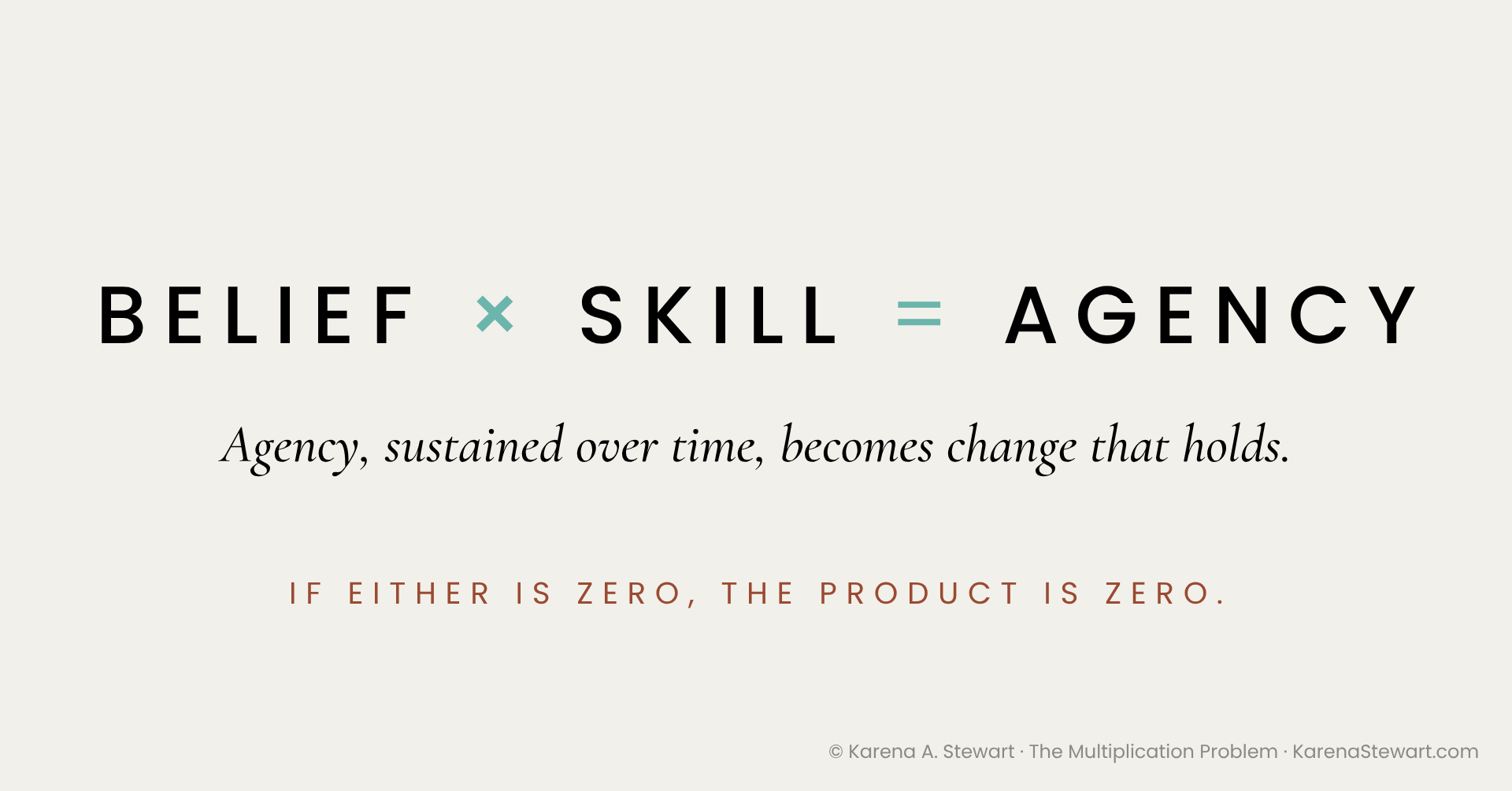
Belief and skill are not additive. They are multiplicative. If either is zero, the product is zero.
Most organizations invest heavily in one and assume the other. That's why most transformations produce a moment instead of a change.
I have watched change efforts fail in both directions.
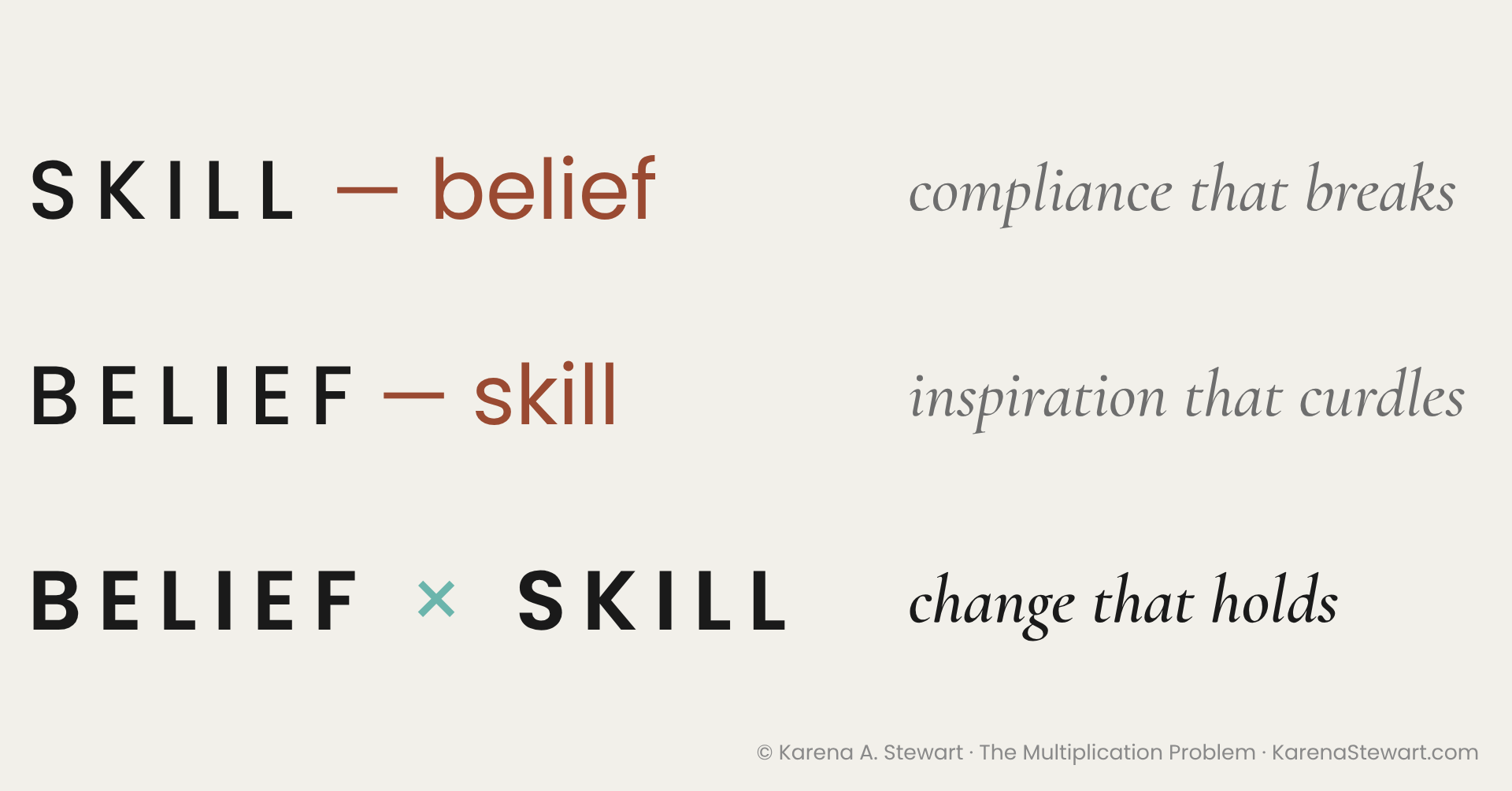
Skill without belief produces compliance. We've all lived a version of this. Think about annual compliance training: content that genuinely matters, and by year two, most of us click through it, a checkbox, not a learning moment. Not because the material is wrong, but because nothing in us has decided it requires anything new of us. Now imagine an entire transformation adopted that way: new behaviors performed while someone is measuring, set aside the first hard week. Compliant change holds in the workshop. It breaks in the hallway.
Belief without skill produces inspiration that can't execute. People leave the kickoff genuinely moved, then face their first tough conversation without the tools to act on it. The conviction collapses, not from lack of will but lack of how. And here's the part nobody budgets for: inspiration without capability doesn't fade. It curdles. A skeptic wants to be convinced and is waiting on evidence. A cynic is what you get when a believer fails one time too many. Most of the cynics in your organization are not immune to belief. They are former believers you didn't equip.
Multiplied together, they produce something neither can alone. In a person, belief times skill creates agency: the point where someone says, I can act, and I will. And agency, exercised across an organization and sustained over time, produces the only outcome worth the investment: change that holds. Not a launch. Not a memory. A new way of operating that survives pressure, survives the gaps between measurements, and survives time.
Belief comes first, and the reason is economic. Every job has a cost of admission, the work people already signed up to do. Change is a tax on top of it, and like any tax, it rarely gets factored into the sticker price of a transformation. Here's what belief changes: people pay a required tax the way we all do, minimally, grudgingly, finding every loophole. People invest in what they believe in. Belief is what turns the tax of change into an investment, effort given because it's right, not extracted because it's required. No training module produces that.
I learned this leading the leadership dimension of an enterprise culture transformation at Macy's. The job was not delivering a program to 10,000 people leaders. It was getting 10,000 people leaders, many with decades of tenure and every reason to treat this as the flavor of the month, to embrace a new standard and live it in everyday moments, long after the launch.
So we asked leaders to go first, and we kept asking. The most senior leaders started months before launch, in private executive coaching, and the privacy was the point: a place to dissent, to wrestle, to fail safely, because you cannot ask leaders to model a change in public that they have never practiced in private. People often act their way into belief, and that's the distinction that matters: the doing that builds belief is small, safe, and practiced. The doing that requires belief is public, costly, and sustained. Build the first before you ask for the second. Then we went a level deeper: 1,700 directors and above through immersive summits, learning alongside executives who by then had months of practice. The change moved like a snowball, level by level, gaining people as it went. At every stage, leaders had to show the level below three things: that they believed it, that they could do it, and that they would make room for others to do it too.
And belief wasn't built by slides. It was built when senior leaders dropped the pretense, and for a moment it wasn't level to level or function to function. It was person to person: someone visibly successful, visibly trusted, saying it wasn't always easy and it wasn't always perfect, but it was right. Transformation fits on a page as a project plan. Belief lives in the blind spots, the things that go unsaid, the moments nobody is measuring.
Skill got equal engineering. We didn't just inspire leaders to be good; we told them plainly what good looks like: a written standard, a shared self-assessment, practice against real situations. Consistency created commonality: shared language, shared expectations, shared momentum, and a shared inflection point. People marked time by it, who we were before we learned this together, and who we became after. And that long-tenured, seen-it-all population? Skeptics walked in. Believers walked out, equipped. (The full story is in the case study on my site.)
That was culture change. The same equation is now being tested at the largest scale in history, because AI has arrived in the workforce.
How AI changes the equation
Organizations are running the classic play: buy the tools, mandate the training, track the usage, declare adoption. Run that through the equation. Belief times skill creates agency; agency, sustained, becomes change that holds. The classic play buys skill and assumes belief, a multiplication with a zero on one side. And the dashboards will hide it, for a while, because dashboards measure utilization, who logged in, while adoption is whether the work actually changed. Those are not the same number, and by the time the gap shows, you've missed the moment when something unsettled could still have been saved.
So before the tools, before the training, leaders should sit with what's actually at stake:
“Everyone is racing to give machines agency. The multiplication problem decides whether your people keep theirs.”
AI doesn't replace the equation. It adds dimension to both sides of it.
Skill gains a dimension. For years we defined skill as what a person can do, and then as what they can get done through people. Now there's a third layer: what they can get done through machines, machines that take on real work reactively, proactively, and at times autonomously. That's not learning new software. It's learning what work to delegate, how to verify what comes back, and how to redesign the work around a machine while keeping accountability human. The process may belong to the machine. The outcome still belongs to a person.
Belief gains a dimension too, and it gets heavier. Sit in any leadership audience when AI integration is announced and you can feel the real questions under the polite ones. Where do the lines get redrawn, where does the machine step in, and where do I step out? What happens to the parts of my value a machine just commoditized? And even if my job is safe today, is my runway getting shorter, is the organization quietly losing its dependency on me?
Leaders won't ask those questions out loud unless they feel safe enough to ask them, and they won't feel safe if the change is dressed up as painless. It isn't. AI will change where work sits and what output is expected, and pretending otherwise insults people's intelligence. Belief doesn't deny the pain of a change. It explains why the pain is worth enduring, and why the outcome can be trusted. The honest offer is this: the machine takes process, people keep purpose, judgment, and accountability, and leadership's job is to redraw the lines out loud, not let people discover them by rumor.
Which brings me to the hardest truth of this shift: AI can power a process. It cannot lead people. And before you say you'd never ask it to, consider this: you may never ask AI to lead your team, but you have asked it to join your team. Every leader knows what happens when a team changes. Roles shift, trust gets renegotiated, and everyone watches how leadership handles it. That's not a tooling decision. It's a leadership moment. No tool builds belief. Leaders do, the same way they always have: by going first, by telling the truth about the cost, and by equipping people to succeed at the thing they're being asked to believe in.
So before your next transformation, cultural or technological, ask two questions.
1. Do our people have the skill to do this?
2. Do they believe it's worth doing?
Answer both with evidence and you're building momentum. Answer only one, all skill or all belief, and you've planned a moment.
And moments end.
Karena Stewart is a Senior Advisor at CAS Strategies, where she partners with clients on the workforce and leadership side of AI adoption.
